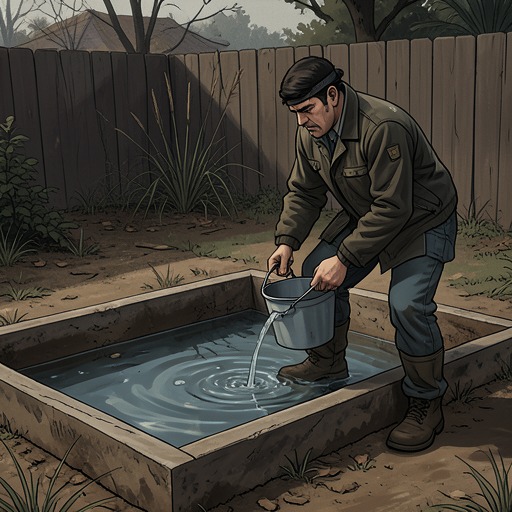
Use giant plastic bags to transport swamp water back to the island
The Summer BookThe water haul in the Enormous Plastic Sausage is the desperate, inventive answer to a drought threatening Sophia’s father’s carefully planted island garden. It is at once a piece of practical engineering and an encounter with a sea that will not behave like a passive route: the filled plastic vessel catches, drags, sinks, and finally reaches the island only through the family’s persistence. The effort saves the garden’s water supply, but its ending also widens the rescue beyond human design, as rain arrives and the island is drenched twice over.
The garden and its water problem
The undertaking grows out of Sophia’s father’s sudden devotion to plants. Flower catalogues arriving by mail absorb him; he orders bulbs from Holland, including a box in which each bulb rests in protective down. A second order brings gifts from Amsterdam, among them a porcelain wooden shoe that serves as a vase and house bulbs called something like Houet van Moujk. Late in autumn he returns alone to the island to plant the bulbs, then spends the winter studying plants, shrubs, and trees. Their delicacy and strict requirements attract him: they need real soil, water at particular times, seasonal covering and uncovering, and protection from field mice, storms, heat, frost, and the sea.
When the family comes back, the scale of the project is visible in the cargo. Two boats tow huge bales of black inland soil; plants wrapped in black plastic, shrubs, trees with roots in sacks, and hundreds of peat pots are carried to the veranda. Spring brings daily sleet and storms. Plants crowd the floor indoors while the family feeds the stove, hangs blankets at the windows, and makes narrow paths between the pots. Outside, the poplar, cement, and shrubs remain under plastic on the veranda. The bad weather delays planting, but it does not stop Sophia’s father from reshaping the ground.
He gets up at six every morning, makes sandwiches, and works outside. He tears up the turf in broad sheets, clears bedrock, digs holes, and fills them with imported black soil. Stone walls shelter the new gardens from wind; trellises give climbing plants support; and he excavates the marsh pond to install a concrete dike. The scale of this work makes the later shortage sharper: the island has been transformed to support delicate growth, but its own water supply cannot meet the garden’s needs.
An engineered supply runs dry
By the time the weather turns warm, the garden has an intricate watering system. Plastic hoses, already sinking halfway into the moss, join through brass couplings at a pump under a box beside the island’s largest natural rainwater basin. A huge plastic cover slows evaporation. Twice a week, Sophia’s father starts the pump and sends warm brown water through hoses and sprinklers. The plants receive different measures: some are watered for one minute, others for three or five, with an egg timer marking the limit on every precious supply.
The careful distribution protects the cultivated plants by withholding water from the rest of the island. The natural turf dries and curls at its edges; several spruces die. Meanwhile, thunderstorms travel along the coast with torrents of rain but never reach the island, and the basin’s level sinks. Sophia prays, without effect. Then, while her father is watering, the pump gurgles, the hose goes slack, and the basin proves completely empty; the plastic cover lies in wrinkled folds against its bottom.
Sophia’s father spends a day thinking, calculating, and drawing plans. He takes the boat to a shop to use the phone, returns to use it again, and finally goes into town by bus. To Sophia and Grandmother, these repeated trips make clear that the situation has become catastrophic. He comes back with an enormous plastic sausage, old-orange in colour, its heavy folds taking up half the boat. The specialized container offers a way to carry water where no ordinary supply can reach, but first it must be filled and hauled over open water in punishing heat.
Filling and towing the plastic vessel
The family sets out immediately with the pump and hoses. The sea lies glossy beneath a wall of clouds over the coast, and the gulls scarcely rise as the boat travels to Bog Skerry. By the time they arrive, the boat is so hot that tar runs, and the plastic sausage stinks. Sophia’s father carries the pump to the deep, sedge- and cotton-grass-filled bog, joins the hoses, and pushes the sausage into shallow water. As the pump runs, the hose straightens across the rock and the vessel slowly swells into a colossal, shining balloon, holding thousands of litres. No one dares speak as it fills.
The first obstacle comes after the pump is switched off. Sophia’s father returns it to the boat, stows the hoses, ties the full sausage firmly to the stern, and puts the family on the middle seat. The motor strains, but the load does not move. He goes ashore to push, without success. On his next attempt he runs and throws himself against the plastic. Both man and vessel slide across the slippery sea grass and into the water. The improvised tow has become a struggle between human effort, the heavy water-filled bag, and the ground beneath it.
Once the boat pulls away, the sausage sinks low, tightening its lines. It creeps through seaweed and disappears when the bay deepens, dragging the motor down until it sputters. The family quickly shifts forward; less than four inches remain between the gunwales and the water. The load’s weight is made harder to predict because the pump has taken in mud and sand along with rainwater. The sausage glides beneath the surface, rises over a reef, and drops on the far side. The motor races, the boat surges and jerks back, and water comes over the stern. Grandmother falls asleep in the heat and petrol smell; dry thunderclaps and black breezes begin to interrupt the still weather.
As they round a long point, another thunderclap sounds. Grandmother wakes to a glassy wave spilling over the stern and realizes she is wet. The air has cooled; clouds race across the sky and the water in the boat feels warm. The family proceeds slowly toward the island under the storm’s shadow, still unsure of what the crossing will bring. In shallower water the sausage strikes bottom repeatedly, forcing more water into the boat until the sea pours over the rail. The weather, the reefs, and the changing depth have turned a planned tow into a precarious passage.
Water reaches the island
Sophia’s father detaches the sputtering motor and wades ashore, with Sophia following and carrying the hose. Grandmother carefully rolls over the side and wades too, swimming a few strokes to remember the sensation before sitting on a rock to pour water from her shoes. The sausage lies beneath the surface, glowing like an apricot. Sophia’s father hauls at it until it rises, its orange body and brass fitting lifted toward the sky. When he reconnects the hoses and starts the pump, mud and sand shoot upward before a stream of water slams onto the rock and scatters moss.
Sophia clasps the pulsing hose and watches water arc over the island into the dry basin. She names the plants the flow is meant to sustain: Clematis, Nelly Moser, Freesia, Fritillaria, Othello, Madame Droutschki, Rhododendron, and Forsythia spectabilis. She runs to the poplar and sees the green root sprout she had expected. At that same moment, warm, tumultuous rain begins. The garden’s transported water and the arriving storm together bless the island, reversing the drought that had made every drop an object of calculation.
Grandmother’s response joins practical scarcity to a pleasure in excess. Having lived frugally all her life, she has a weakness for extravagance; she watches water fill and overflow the basin, barrels, and crevices in the granite. Mattresses are out airing, and dishes wash themselves in the downpour. Even with water everywhere, she fills a coffee cup with drinking water and pours it over a daisy. The gesture closes the haul with a small, deliberate use of abundance: the water that had required elaborate machinery, a dangerous crossing, and hard physical labor is now available for one flower.